
Know The Costs Related to the Sale of Your Home
Selling your home at a good valuation is always a treat because you can now focus on buying that new property you’ve been eyeing or using the money to fulfill your urgent needs. However, you typically do not get the exact amount you sold the home for because there are a few home selling costs in Marco Island, FL that you should know beforehand to plan your pricing and budgeting accordingly.
At William Reynoso, we make selling your property as smooth as possible. We always guide clients about Marco Island real estate selling fees and all other costs they’ll come across for full transparency.
WHAT COSTS ARE RELATED TO THE SALE:
Mortgage Pay Off
Before the closing, you will sign a release for the Title Company or Attorney to get the amount that will be owed at the day of closing. This will allow the Closing Company to prepare the closing documents and they will issue a check out of your proceeds at the closing to pay off your outstanding mortgage.
Lines of credit or Equity lines
As with the mortgage pay off, you will have to authorize the closing company to get this information. If there is any amounts owed, they also will be paid off and any lines of credit closed.
Prepayment Penalty
Often, sellers think that all that is owed is the amount showing on their last statement. This is not always true. A prepayment penalty could be in your mortgage. You may also owe interest depending on the day of the month that you close.
Unpaid Taxes/Liens
This is why title work is important prior to closing to see if there are any liens or unpaid taxes on the title. These items will also have to be paid the day of closing. The closing company cuts these checks out of your proceeds and pays them on your behalf.
Special Assessments
Special assessments are things like water, sewer, road or other local government improvements that were assessed to the property. In most cases they must be paid off, in others, they can be assumed by the buyer. If they are to be paid off, again the closing company will pay these out of your proceeds.
Let’s Discuss Marco Island Home Selling Expenses
Selling your home in Marco Island FL can feel overwhelming. You’re probably wondering about all the hidden costs that pop up during the home selling process. We get it—no one likes surprises regarding money, especially with such a big transaction.
Here’s what you need to know about the selling costs of putting your Marco Island property on the market.
1. Loan Payoffs & Related Costs
The first major expense is paying off your existing loans. Your real estate transaction starts with clearing these obligations. Most sellers don’t realize there’s more to it than the balance on their last statement.

Your primary mortgage payoff usually includes:
- The remaining loan balance plus any accrued interest
- Possible prepayment penalties (Lenders usually calculate prepayment penalty in two ways: 1-2% of the remaining balance or three months’ interest.)
- Additional loan processing fees
If you have a HELOC (Home Equity Line of Credit), that needs to be paid off, too. As your Marco Island realtor, William can help you calculate these exact amounts with your lender.
2. Special Assessments
These are assessments for water, sewer, road, or other local government improvements made within the property region.
In most cases, you need to pay the special assessment taxes. However, in some cases, the buyers can assume them as well. If they are to be paid off, the closing company will again pay these out of your proceeds.
For example, if your neighborhood is getting new water lines installed for $1 million and there are 200 homes, each property might be assessed as $5,000. This amount could either be paid in full at closing or, if allowed and agreed upon, transferred to the buyer to pay over time.
3. Real Estate Agent Commissions
The US real estate agent commissions currently average 5.46% of the sale price, typically split between listing and buyer agents.
For example, on Marco Island’s median home price of $1,220,000, the total commission would be $66,612, split between the listing agent and the buyer’s agent.
However, due to recent legal settlements in 2024, this structure is changing significantly – sellers are no longer automatically required to pay the buyer’s agent commission, and buyers may need to negotiate and pay their own agent’s fees directly.
4. Closing Costs
When working with a Marco Island realtor, commission rates typically make up the largest portion of your costs. However, there are other significant expenses to consider, too.
[table id=1 /]
Here’s a detailed breakdown of what you’re responsible for:
- Escrow fees: Usually 1-2% of the purchase price and is often split between buyer and seller. However, sellers can offer to pay it all to attract buyers.
- Documentary stamp tax: $0.70 per $100 of sale price
- Title search and exam fees: $75-200
- Title insurance: You may have to pay for full or part of title insurance as well, which can be 5 percent of the total property cost
- Legal assistance: Optional attorney fees if you choose legal representation
You’ll want to factor these numbers into your bottom line when considering a Marco Island FL home selling process
5. Home Preparation & Staging Costs
As per the data given by Statista, professional home preparation and staging costs in the US go above $6,000, including everything from house and carpet cleaning to lawn care, full house painting, and professional staging. Here’s a breakdown of costs:

Here are key insights as per this data:
Cost Breakdown Insights:
- Exterior painting represents the highest cost at $2,600
- Interior painting is the second-highest expense at $1,245
- Professional staging is a significant investment at $1,805
- Basic maintenance costs (cleaning and lawn care) total only $445
Though initial spending on your home preparation seems costly, especially painting and staging, this works in your favor. Painting the house boosts its financial value and also appeals to buyers because the exterior is the first introduction of your house to potential buyers. Moreover, staging the house helps sell it better and faster. Here are some staging trends observed in the home selling market:
Key ROI and Impact Statistics:
- Staged homes spend 73% less time on market
- 85% of staged homes sold for 5-23% over listing price
- 82% of buyers find it easier to visualize staged properties as their future home
- Professional staging typically yields a 5-15% return on investment
- Painting investments show 100-150% ROI potential
In addition to these costs, you will also need to invest in professional real estate photographers for online listings. The costs for high-quality shoots with 10-20 photos can range from $100 to $300. Premium shoots, including drone shots and virtual tours, can cost above $1,000.
Pro Tip: Your living room should be given the most importance, as 46% of buyers find it the most important. This is followed by the master bedroom, which is preferred by 43% of buyers. Staging the kitchen is important to 35% of the buyers, followed by other rooms in the home, which 24% of the buyers like to see.
6. Minor Repairs Before Selling
Home repair expenses are not fixed as the extent of repairs varies from home to home. Nevertheless, keep a few hundred bucks in mind at the very least because almost every house needs common minor repairs such as:
- Fixing leaky faucets
- Broken light switches
- Small wall cracks
- Replacing worn-out handles
- Faulty fixtures
- Changing cabinet sheets
You can also choose to sell the home as is and have the buyer deduct repair costs from the price based on the estimate they get after inspection.

7. Concessions to Buyers
The commission your realtor earns isn’t the only cost. Buyer concessions often come into play during negotiations. These can range from 2-3% of the closing costs on average.
Maximum seller concessions range from 3-6 percent due to limits set by lenders. FHA loans permit up to 6% of the purchase price or appraised value. VA loans cap realtor commissions at 4%, while USDA loans allow up to 6%.
For example, On a $300,000 home, a 3% concession gives buyers $9,000 toward their expenses. This might cover appraisal fees, recording fees, title searches, loan fees, inspections, HOA fees, or taxes.
Some sellers offer home warranties as incentives. These cover major systems and appliances for the new owners. Price adjustments can also work as concessions. If inspections reveal needed repairs, you might reduce the price accordingly.
8. Misc Fees & Tax Implications
Selling your home comes with hidden costs that often catch many owners off-guard. Several smaller selling costs can add up quickly during a real estate transaction.
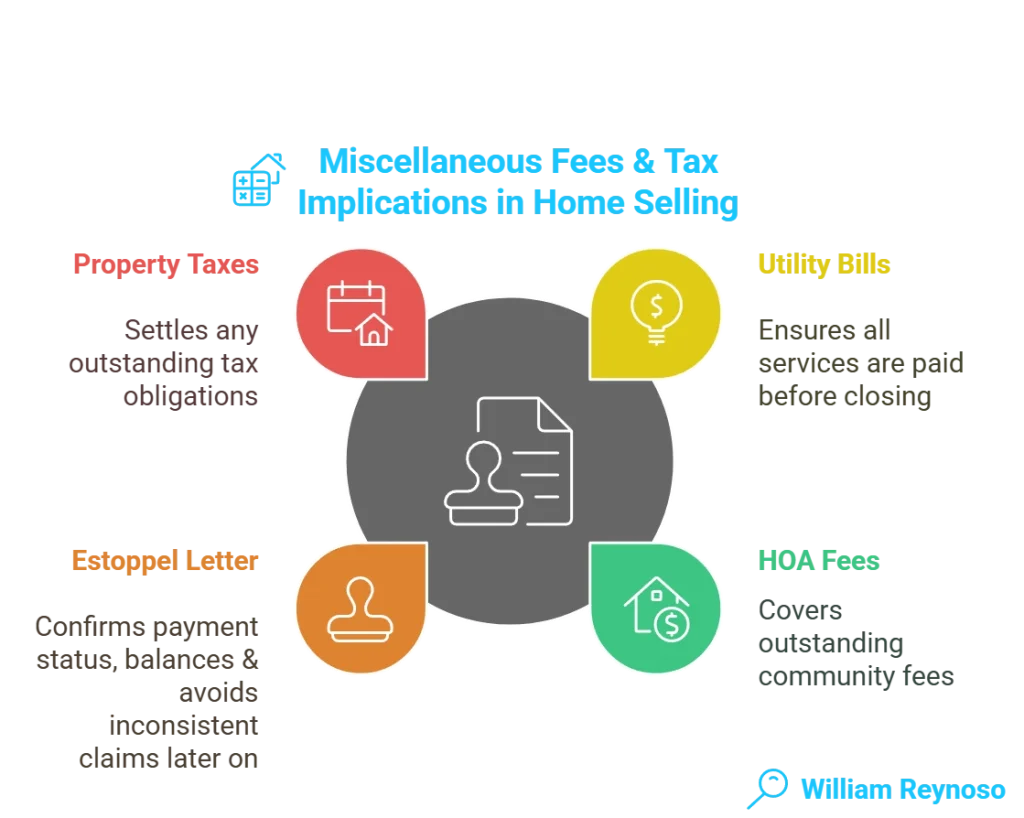
Here are some miscellaneous fees and taxes you need to pay before selling the home to avoid unpleasant surprises with your closing costs.
Outstanding Utility Bills
Your sale can’t proceed without payment of utility balances. The realtor will verify that all utilities are current before closing. These must be paid in full as part of your transaction costs.
HOA and Condo Fees
Most Condos and some single-family homes in Florida have HOAs or condo fees that require settlement. Your rates must be current through the closing date.
The realtor commission process includes verifying these payments. Any outstanding HOA or condo fees will come from your proceeds. Transfer fees typically range from $100 to $500.
Condo Estoppel Letters
Condo sales require an estoppel letter for closing. These letters confirm your payment status, any outstanding balances, and ensure no inconsistent claims are made later on. Basic processing costs between $250 to $500.
Rush processing or delinquent accounts face higher fees. Your HOA documents specify the exact costs. Florida law sets maximum limits on these fees to protect owners.
Here’s what determines your estoppel letter cost:
- Standard processing time: $250
- Rush processing requests: Up to $100 extra
- Current versus delinquent accounts: Up to $150 extra
All these expenses impact your final proceeds from the sale. Understanding them helps prevent issues during closing. A qualified real estate agent can explain which fees apply to your property.
Each property type has its own fee structure. Condos generally have more fees than single-family homes. Keep good records of all your payments. This makes the closing process much smoother.
Prorated Property Taxes (up to date of closing).
This is why title work is crucial before closing to see if there are any liens or unpaid taxes on the title.
These items will also have to be paid on the closing date. The closing company cuts these checks out of your proceeds and pays them on your behalf.
Example Rundown of Marco Island Real Estate Transaction Costs
Still wondering how much does it cost to sell a house in Marco Island? Let’s give you a perspective with an example. Let’s say a property is being sold for $500k in Marco Island. Here’s what to expect in terms of selling costs and expenses:
[table id=3 /]
Note: This is an estimate. Actual costs may vary based on specific circumstances, property conditions, and negotiated terms. Property taxes are prorated and depend on local rates. Additional costs may apply if there’s a mortgage payoff or other liens.
Ready to Sell Your Home? Hire Willian Reynoso To Sell in Best Prices:
Want a detailed explanation of how much it can cost to sell your home and what your net amount will be? Call William Reynoso at 239-778-4958 for a quick consultation.
You don’t have to estimate selling costs alone. We can help you determine transaction costs and price your property so that you don’t sell at a loss.
At William Reynoso, we care about you and your property. You’ll never be left alone to figure things out on your own; we’ll be fully dedicated to selling your property fast and at a good price!
Frequently Asked Questions:
What Some Home Selling Strategies in Marco Island FL, that Save Money?
One of the top tips for selling a house in Marco Island that we can give you is to negotiate Marco Island realtor commission rates (averaging 5.46%) by finding agents who include marketing services, photography, and online listing so you save on these costs. Plus, handle basic home prep yourself while only professionally staging key room.
What are the closing costs in Marco Island and total selling costs to expect?
Plan for selling costs of approximately 8-10% of your home’s sale price. For a $500,000 real estate transaction, budget around $40,000-50,000 in total transaction costs, including realtor commission, settlement fees, closing costs, preparation expenses, and potential buyer concessions. Cash buyers might help reduce some of these expenses.
What’s different about selling condos vs. single-family homes?
Condos involve more complex fee structures and association requirements, while single-family homes need more attention to exterior maintenance and landscaping. Real estate agents recommend getting a property appraisal for both types to ensure accurate pricing.
How do waterfront properties differ in the sale process?
Waterfront properties require additional inspections special insurance considerations, and typically command higher commission rates. A realtor with waterfront property expertise can provide specialized marketing to reach qualified buyers.
What home improvements offer the best return?
The best rates of return come from curb appeal improvements, minor kitchen updates, fresh paint, and thorough cleaning. Your Marco Island realtor commission rates (averaging 5.46%) often include consultation on which improvements will maximize home valuation.
How long does it typically take to sell?
During peak season (March-June), well-priced homes often sell within 30-60 days. Working with an experienced realtor can help optimize timing and commission negotiations.
Which costs are negotiable at closing?
While documentary stamp tax ($0.70 per $100) is fixed, title insurance, escrow fees, and other closing costs can be negotiated. A skilled realtor can help minimize these expenses.
What buyer incentives work best?
Popular incentives include home warranties ($400-600), closing cost assistance (2-3% of purchase price), and hurricane protection upgrades. The effectiveness varies by season and real estate market conditions.